
There are wildlife reserves that challenge photographers with density and darkness, and others that offer sightings so staged they feel rehearsed. Pench National Park belongs to a rarer category. It is a place where the forest collaborates. Not by making things easy, but by making them legible.
Set across the undulating landscape of southern Madhya Pradesh, Pench is defined by openness. Teak forests thin into grassland, bamboo brakes give way to shallow riverbeds, and the canopy lifts often enough to let light behave like a willing participant rather than a hostile force. For wildlife photographers, this matters more than sheer animal numbers. Light, after all, is the difference between evidence and image.
Pench’s geography is unusually generous. The park is threaded with wide forest roads and natural clearings that create long sightlines, allowing photographers to see animals not as sudden interruptions but as moving elements within a larger frame. Tigers here are often photographed walking through space rather than emerging abruptly from it. This spatial generosity encourages composition that includes habitat, scale, and context. It is the difference between a portrait and a sentence.
This landscape is no accident. Pench lies at the meeting point of the Satpura and Maikal ranges, a transitional zone that supports an impressive range of species. Tigers are the undisputed headline, and Pench has earned its reputation as one of central India’s most reliable reserves for sightings. Yet reliability does not translate into predictability. Tigers in Pench are calm around vehicles, but they retain the right to indifference. They cross roads with unhurried confidence, pause briefly, and vanish into bamboo that seems to fold around them like a curtain.
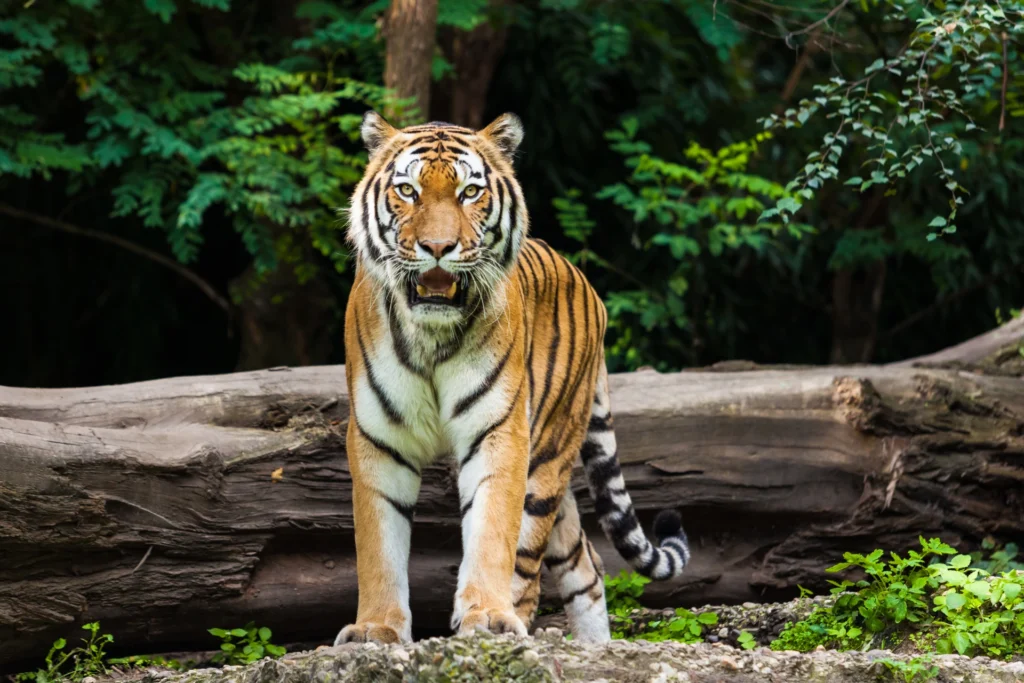
For photographers, this behavior is ideal. Calm animals allow time to compose, to adjust exposure, to wait for posture and gesture. Pench tigers are frequently seen in motion, walking rather than posing, which lends itself to dynamic images that suggest intent rather than spectacle. A tiger in Pench is often photographed mid-stride, muscles extended, tail balanced, the forest receding behind it. These are images that feel lived-in rather than captured.
But Pench is not only a tiger reserve. It is also one of the strongest landscapes in India for photographing ecological relationships. Chital and sambar deer are abundant and expressive, their alarm calls acting as narrative cues for the attentive photographer. Gaur appear with a kind of industrial authority, their bulk altering the visual weight of any frame they enter. Wild dogs, when present, offer rare opportunities to photograph coordinated movement and social structure, often in open terrain where shutter speed and anticipation matter more than luck.
Leopards are the reserve’s quiet footnote, occasionally revealed through a glance from a rock or a sudden crossing at dawn. Their elusiveness sharpens the photographer’s instincts, training the eye to scan edges and negative space rather than the obvious center.
Birdlife adds another dimension. Pench’s openness supports raptors like crested serpent eagles and honey buzzards, while rollers, bee-eaters, and kingfishers bring color and motion to the mid-ground. For photographers who resist the temptation to chase only large mammals, the reserve offers constant peripheral activity. Pench rewards those who understand that the frame does not end with the subject.
Perhaps the most underrated advantage Pench offers photographers is time. The structure of safaris here, combined with good road networks and manageable terrain, allows repeated access to similar zones over multiple days. This repetition builds familiarity. You begin to recognize particular bends in the road, favored shade trees, habitual crossing points. Photography shifts from reaction to anticipation. You are no longer hoping for an image. You are preparing for one.
Light, again, plays its role. Morning in Pench is often cool and clear, with low-angle sunlight filtering cleanly through grass and bamboo. Afternoon light arrives warmer, dustier, more dramatic. Silhouettes, rim lighting, and layered compositions become possible without excessive technical struggle. Pench does not flatten images. It gives them depth.
There is also something psychological at work. Pench does not overwhelm. It allows photographers to think. To observe behavior. To wait. In a world increasingly shaped by instant gratification, this is a quiet luxury. The forest teaches patience not as a moral virtue, but as a practical skill.
In the end, Pench is a photographer’s paradise not because it guarantees sightings, but because it offers coherence. The animals, the light, the terrain, and the rhythm of the forest align often enough to allow meaning to emerge. Images made here tend to feel intentional rather than accidental.
Pench does not shout. It speaks clearly. And for wildlife photographers willing to listen, that clarity is everything.