
A dispatch from Pench’s working wilderness
Log 1
A good naturalist does not begin with the tiger. That is tourist thinking, perfectly understandable, and occasionally rewarded. A good naturalist begins with the forest’s small disclosures: the damp seam of a pugmark pressed into dust, the sudden hush of chital, the way a bamboo clump holds yesterday’s wind like a secret. At Haldu Tola, set in the Pench landscape, the notes start even before the first safari. You begin collecting evidence the moment you step outside.
The setting does most of the teaching. Pench is a classic Central Indian dry and moist deciduous system, a mosaic of teak, mixed forest patches, bamboo thickets, and open grasslands stitched together by seasonal streams and the Pench River. This habitat heterogeneity is not botanical trivia. It is the reason the food web here holds. The grasses and understory feed the herbivores. The herbivores feed the predators. Everything else is commentary.
At dawn, the forest begins like a slow reveal. You move through a palette of teak trunks and pale dust, scanning for the first animal that will betray the day’s direction. Often it is chital, India’s spotted deer, assembled in large, alert herds. Sambar appear heavier, more deliberate, their presence suggesting better cover and deeper shade. Nilgai, wild boar, and gaur complete the herbivore story, each adding a different weight and texture to the scene. In Pench, the abundance of ungulates is not just pleasing to see. It is a biological signpost. A healthy prey base is the foundation that makes everything else possible.
Then there are the predators, arranged like a hierarchy that is never quite as tidy as brochures imply. Tigers are the keystone, and Pench is rightly celebrated for them, but the more interesting moments often come from the supporting cast. Leopards, tacticians of overlap, appear and vanish with a kind of practiced discretion. Sloth bears shamble through termite country, all shaggy conviction and unexpected speed. Dhole, the Indian wild dog, arrive like coordinated punctuation, packs moving with intent that is obvious even at distance. Jackals, foxes, civets, jungle cats, and hyenas fill out the nocturnal and crepuscular margins.
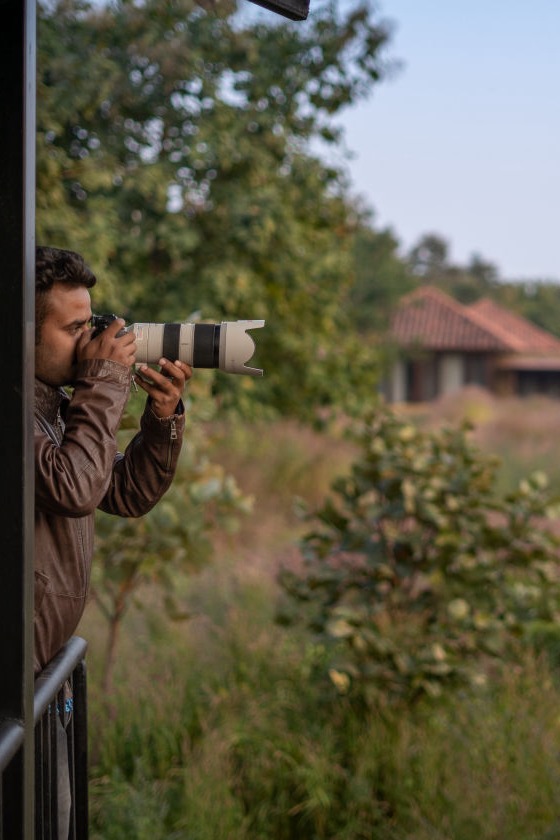
A naturalist’s notebook at Haldu Tola also belongs to the air. Pench has serious birdlife, and the photographer who treats birds as consolation prizes is missing the plot. Raptors like crested serpent eagles and owls hold the canopy’s upper tiers, while rollers, paradise flycatchers, and peafowl animate the mid-story and edges. Over time, you learn that birds do not simply decorate the forest. They report on it. They mark fruiting trees, reveal insect blooms, and sometimes, with a well-timed alarm, rewrite your entire morning’s strategy.
And then there is Haldu Tola itself, which behaves less like a conventional lodge and more like a quietly argued thesis: that hospitality can be built as an ecological participant, not just an observer. In a region where water is precious and energy systems often rely on heavy logistics, Haldu Tola’s operational choices are part of the story you are here to document. The property describes an expansive solar setup with battery storage, rainwater harvesting, access to subterranean aquifers, and on-site water purification through reverse osmosis. Even the pool filtration is designed to reduce chlorine use, and sparkling water is produced in-house to reduce plastic. These details sound domestic until you place them back into context: Pench is a landscape where the dry season is not a mood, it is a governing fact. Resource decisions have ecological consequence.
Field notes here, in other words, include infrastructure. The naturalist’s eye expands to include systems that keep humans comfortable without asking the forest to pay the bill. You begin photographing water points and solar arrays with the same seriousness you give to tiger tracks, because both are part of the same modern ecology. One is older. One is new. Both determine what survives.
Haldu Tola’s cultural dimension sharpens this further. The Gond and Bhil artists who have contributed to the villa’s frescoes and carved doors are not “local color.” They are, in a very real way, ecological archivists. Their motifs frequently echo forest species, seasonal cycles, and the grammar of the land. When you sit with a naturalist, you learn to read spoor. When you sit with an artist, you learn to read memory. Together, they widen the definition of biodiversity beyond what the mammal checklist can hold.
By the time you leave, your notes will contain the obvious entries: tiger, leopard, dhole, gaur. But the more valuable lines will be the ones about relationships. Chital density near grassland edges. Sambar preferring deeper cover. Bamboo acting as both refuge and visual trap. A raptor’s shadow flickering over a clearing just before the forest goes still. The way the place teaches you to pay attention, and then rewards you for it.
That is the promise of Haldu Tola, and of Pench itself. Not guaranteed drama, but guaranteed meaning for anyone willing to look closely.
References
“Pench Tiger Reserve” overview (flora, fauna, habitat notes). (Wikipedia)
National Tiger Conservation Authority (NTCA), “Pench Tiger Reserve (Madhya Pradesh) brief note.” (ntca.gov.in)
Haldu Tola, “Sustainability at Haldu Tola.” (haldutola.com)
Avibase, “Pench Tiger reserve bird checklist.” (avibase.bsc-eoc.org)
Maharashtra Tourism, “Pench Tiger Reserve.” (maharashtratourism.gov.in)