
There is something singularly humbling about the forest at first light. In the pre-dawn hush, as the gate to Pench Tiger Reserve creaks open and the tyres of your safari jeep crunch over dry sal leaves, you become part of something ancient—something that predates language, routine, and the human rush. A morning safari at Pench is not just an excursion; it is a communion.
As the first rays of sun begin to sift through the teak and tendu trees, the jungle exhales. The temperature is still forgiving, the air laced with petrichor and wild lemon grass, and the undergrowth shimmers in dew. It is the hour when the forest is most alive—and most alert.
The calls begin softly, like a slow overture.
A spotted owlet retreats into foliage. Langurs clear their throats with their signature hoots. A golden jackal slinks back from a night hunt. Every sound is a code; every rustle, a message. But nothing quite captures attention like the abrupt, urgent bark of a sambar deer. It’s an alarm call—a signal that a predator is near.
Your naturalist leans forward, scanning the thicket with trained eyes.
In Pench, these guides are not mere drivers—they are interpreters of silence, scholars of the invisible. As the vehicle moves into a dry riverbed, tyre tracks briefly parallel the paw prints of something much larger. Wide and rounded, set with deliberate distance—tiger.
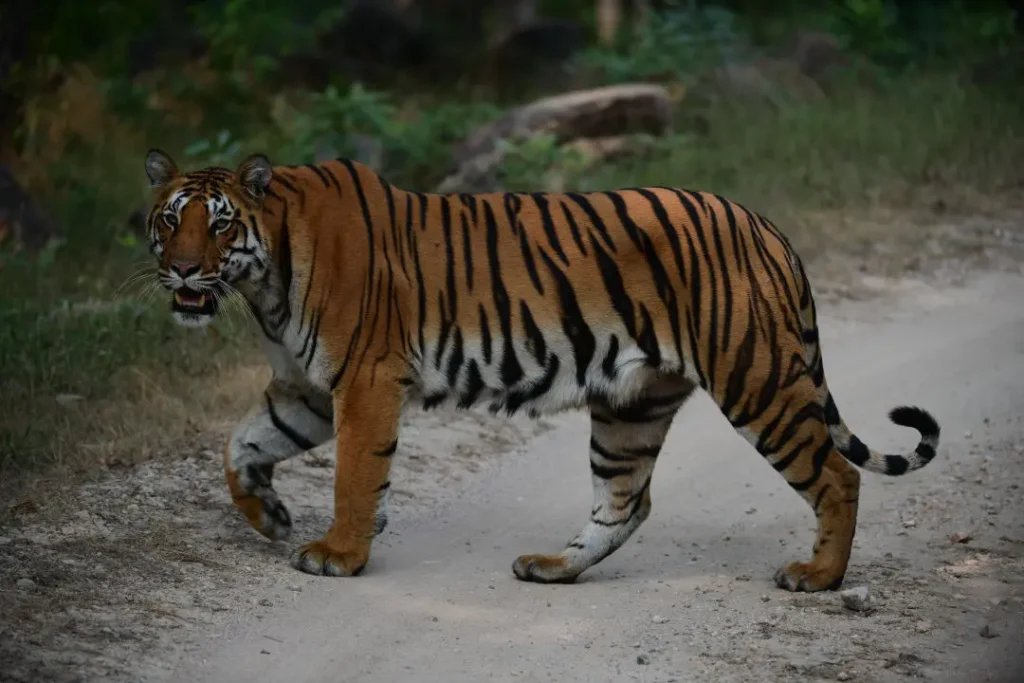
The tension builds. You learn quickly that in the jungle, drama resides in the anticipation. You scan the lantana underbrush, the tree line, the dusty trail ahead. You wait. And then, in a moment as fleeting as it is eternal, she emerges.
A tigress, regal and unhurried, melts out of the golden grass. Her gait is liquid, her ears twitch with focus, her amber eyes momentarily meet yours—and for a few seconds, you are held still in a gaze both majestic and wild. She is gone as silently as she arrived, but the pulse she leaves behind continues to echo.
While the tiger may be the star of the show, Pench’s supporting cast is equally compelling. Herds of chital (spotted deer) move like shadows across the sun-dappled forest floor. Nilgai—India’s blue bulls—graze in clearings, their powerful frames betraying unexpected gentleness. Overhead, the brilliantly coloured Indian roller wheels across the sky, its wings flashing blue with every beat.
Birdwatchers find this time particularly rewarding. The racket-tailed drongo performs its mimicry like a jazz soloist, while the crested serpent eagle surveys the land from a teak perch. Pench is home to over 285 species of birds, and the dawn hours offer a front-row seat to their avian congress.
The landscape itself changes rapidly in these hours—from deep shadows to shafts of light that pour through the canopy like golden syrup. Every bend in the trail is a new canvas: a termite mound where a sloth bear may have foraged the night before, a sun-warmed rock where a monitor lizard rests, a shallow pool bearing the quiet memory of a leopard’s thirst.
At the mid-point of the drive, you stop. Breakfast is laid out at a designated forest rest point: masala chai, sandwiches, hard-boiled eggs, and biscuits. The conversation is animated, the excitement still fresh. There’s a shared understanding that this morning has offered something no urban sunrise ever could—an invitation into the raw, rhythmic choreography of the wild.
As you drive back toward the gate, the jungle seems to retreat a little—its drama played out, its audience satisfied. But make no mistake: the forest never sleeps. It merely changes its mask.
The morning safari at Pench is not about chasing sightings, though they are undeniably thrilling. It is about witnessing nature in its truest form: unpredictable, unscripted, and endlessly fascinating. It’s about waking up not just to the forest, but to yourself.
In those early hours, among rustling teak leaves and golden shafts of sun, you remember that you, too, are part of this wild, turning world. And for once, you’re exactly where you belong.