
The first safari in Pench does not announce itself with spectacle. There is no orchestral swell, no cinematic reveal. Instead, it begins in near darkness, with the sound of canvas chairs scraping softly against stone, the muted click of camera lenses being checked for the third time, and the unmistakable chill of dawn that lingers just long enough to remind you that forests, like good stories, keep their own time.
Pench National Park lies along the southern reaches of Madhya Pradesh, its landscape shaped by teak forests, bamboo thickets, seasonal streams, and wide grass meadows. This is tiger country, but it is also deer country, bird country, termite-mound country. To enter Pench expecting a tiger on demand is to misunderstand its grammar. The forest prefers to introduce itself slowly.
As your jeep rolls through the gate, the first thing you notice is the light. It filters unevenly through sal and teak, landing in pockets rather than flooding the forest floor. This light dictates everything: how animals move, where they pause, how long they remain visible. The experienced naturalist will tell you to watch the light before you watch the animals. Tigers, after all, are masters of using both.
Early sightings are often modest and instructive. A chital herd lifts its heads in unison, ears angled like antennae. A langur issues a sharp alarm call that seems too specific to ignore. A peacock crosses the track with theatrical indifference. These are not distractions. They are the opening paragraphs of the morning, clues embedded in behaviour rather than appearance.
Pench’s tigers are famously relaxed around vehicles, but relaxed does not mean predictable. A tiger may walk the road with the confidence of a local, then vanish into bamboo so dense it appears physically implausible. When this happens, there is a collective recalibration inside the jeep. Lenses lower. Breaths resume. The forest resumes speaking.
What distinguishes Pench from many reserves is its openness. The meadows near the Pench River allow longer sightlines, making it possible to see animals not just as subjects but as part of a broader ecological composition. A tiger crossing grassland at sunrise becomes less a portrait and more a sentence about scale, territory, and light. Photographers quickly learn that the most compelling images here often include more environment than animal.
The supporting cast is formidable. Gaur emerge from the forest like armoured vehicles, their sheer mass quietly astonishing. Sambar move with a deliberate grace that suggests seniority. Wild dogs, when encountered, arrive like punctuation marks, swift and decisive, their pack dynamics unfolding in real time. Leopards appear occasionally and briefly, as if aware of their own reputation.
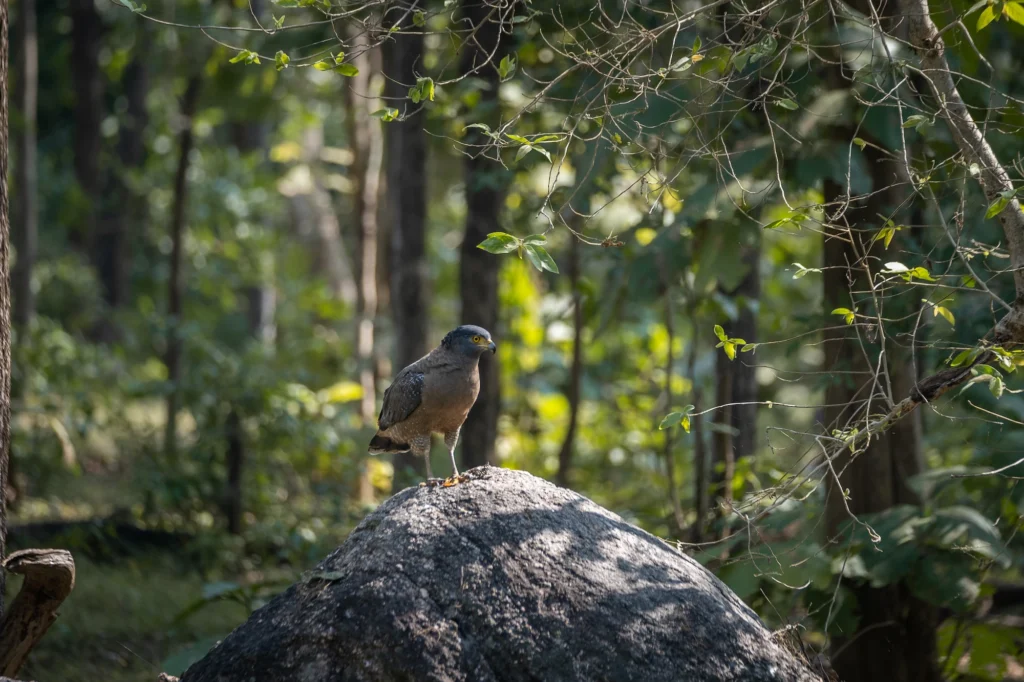
Birdlife fills the margins. Crested serpent eagles scan from high perches. Rollers streak across clearings in improbable blues. Kingfishers hold still over water long enough to make you question whether you imagined them. Pench rewards attention to the periphery, to the spaces between headline sightings.
By mid-morning, the forest begins to warm. Shadows retreat. Activity slows. The safari ends not with a crescendo but with a gentle easing out, the jeep turning back as the forest settles into its quieter hours. Over breakfast, conversations are measured, analytical, often retrospective. What did that alarm call mean? Why did the deer move the way they did? Could the tiger have doubled back?
The first safari in Pench recalibrates expectations. It teaches you that wildlife viewing is not about accumulation but interpretation. That a good morning may not produce a tiger photograph but might offer something more valuable: an understanding of how this forest breathes.
And that understanding lingers. Long after the dust has settled and the cameras are set down, Pench has a way of staying with you. Not as a catalogue of sightings, but as a landscape that taught you how to look, how to wait, and how to read the subtle language of the wild.